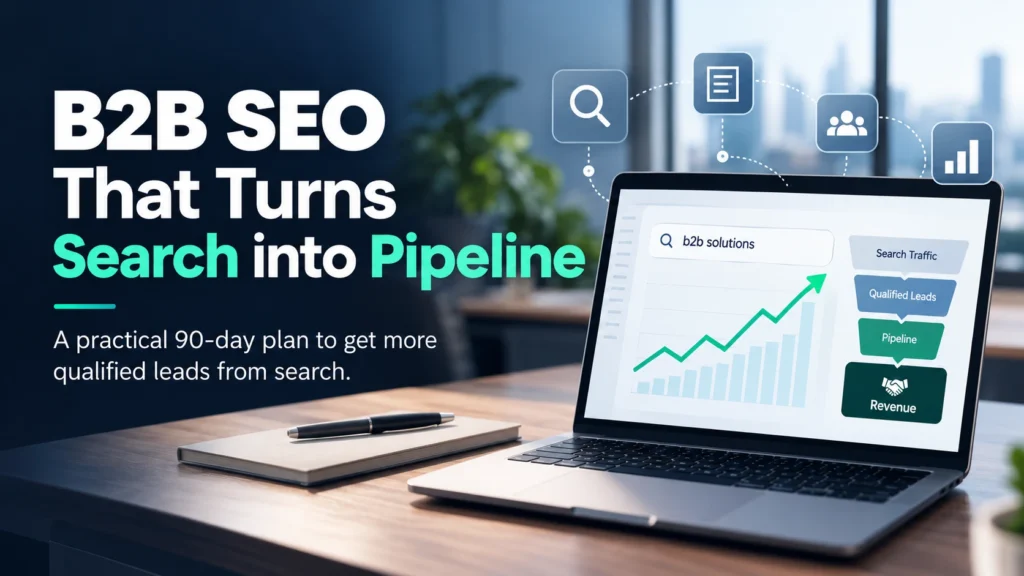
Most B2B companies don’t have a traffic problem. They have a pipeline problem. Rankings climb, the dashboard looks healthy, and sales still asks where the leads are.
At Digitrove Digital, we build B2B SEO around one question: what do your buyers search before they ever contact you? Here is how we approach it, and the 90-day plan we’d follow for a US B2B company.
Key takeaways
- B2B buyers search for specific problems, applications and specs, not your industry name.
- Niche pages win. Broad “Industries We Serve” pages rarely do.
- Measure form fills and pipeline, not rankings.
- Expect real lead growth in four to six months, with early signals sooner.
Why B2B SEO is different
Your buyer isn’t impulse-buying. They research for weeks, share links with a buying committee, and often avoid sales calls early on. Gartner’s 2025 survey found that 61% of B2B buyers prefer a rep-free buying experience. Your website is doing the first sales call.
Three things follow:
- Searches are national and non-branded. Buyers type the exact problem, not “near me.”
- The cycle is long. A page that ranks in March may close in September.
- Phones rarely ring. Form fills, demo requests and quote requests are the scoreboard.
Build niche pages, not “Industries We Serve” pages
Most B2B sites have a row of industry pages written for people already on the site. They rarely rank for anything but the company name.
A niche page starts from a search with real intent: “NetSuite implementation for distributors,” “Odoo ERP for small manufacturers” or “invoice factoring for staffing agencies.” The volume is lower, but the buyer is closer to a decision, and you compete with a handful of pages instead of hundreds.
We build four types:
- Application pages: what you do for one specific use
- Industry-within-industry pages: “medical device contract manufacturing,” not “healthcare”
- Spec and capability pages: facts an engineer or buyer can scan and forward
- Comparison and process pages: “X vs Y,” “how onboarding works,” “what to send for a quote”
Keep your broad industry pages as hubs that link down to these.
Not sure which niche pages your competitors haven’t built yet? Get a free B2B SEO audit →
Create content that supports your money pages
Content should feed the pages that sell, not replace them. Start with one cornerstone piece per major topic, such as a buyer’s guide, a spec reference or your own benchmark. It earns links and becomes the page everything else points to. Then publish two or three strong long-tail articles a month, each linking to the service page it supports.
Before writing anything, check page one of Google. If it’s full of service pages, a blog post won’t rank there. If it’s full of guides, a sales page won’t. Match the format that already wins.
We often see sites with years of ranking articles while the actual service page is a paragraph and a form. Fix that page first.
Get found in AI answers
Buyers now ask ChatGPT, Gemini and Perplexity to compare suppliers, then click through to verify. The work overlaps heavily with good SEO:
- Add FAQs to your key pages.
- Write specs as plain text, not only PDFs.
- Keep company details consistent across directories.
- Earn mentions on industry sites that assistants already trust.
Don’t rebuild your strategy around AI search and Answer Engine Optimization (AEO). The volumes are still small next to organic. But it costs little to be ready.
Measure pipeline, not rankings
Before we publish anything, we submit every form ourselves, set up conversion tracking by page and source, and connect it to your CRM where possible. A broken form stays invisible until someone checks.
Our monthly report covers non-branded keywords, organic leads by page and, where you can share it, pipeline and closed revenue. If traffic dips but qualified leads hold, that isn’t failure. The traffic that left was probably never going to buy.
The 90-day B2B SEO plan
- Days 1-15: Audit and tracking. Test forms, set up GA4 key events and Search Console, and link your CRM.
- Days 15-30: Money keywords. Build the list from your sales team’s call phrases, competitor gaps and the questions in your quote requests. Keep it non-branded.
- Days 30-60: Niche pages. Publish the first five to ten, with a clear H1, an honest title, specs written as facts and one obvious next step.
- Days 60-90: Content and reporting. Publish your cornerstone piece and first supporting articles, add internal links and deliver the first lead report.
An honest timeline: expect early ranking movement within 90 days. Steady lead growth usually takes four to six months, and longer in crowded niches. [Add one line of proof here: a client result or approach that shows you’ve done this.]
Frequently asked questions
How long does B2B SEO take?
Plan on four to six months to see results, and longer in competitive niches. The first months go into tracking, keyword research and niche pages that pay off later.
How much does B2B SEO cost in the USA?
It depends on scope, competition and content volume. [Add your starting range or how you scope projects.]
Is SEO still worth it with AI search?
Yes. AI assistants build answers from pages that rank and from trusted sources, so strong SEO helps you get cited too. Learn more about Digitrove Digital’s AEO services.
What should I ask a B2B SEO agency before hiring?
Ask who runs your account, what happens in month one, how leads are tracked to your CRM and which non-branded keywords they’ll report on. Be wary of reports built on rankings alone. Explore our approach to SEO for SaaS and B2B technology companies.
Ready to turn search into pipeline? Digitrove Digital builds B2B SEO plans for US companies, focused on leads rather than traffic. Get your free proposal →
Find the digital growth gaps affecting your clinic
Digitrove Digital helps clinics, hospitals and healthcare organisations identify SEO, AI-search, content and conversion gaps that may be limiting patient acquisition.
Request a Free Initial Review